Tiny Ice Age Toad Reveals Clues to Los Angeles' Ancient Climate
Scientists at the La Brea Tar Pits have discovered a new extinct amphibian species, the Ice Age spadefoot toad, which provides surprising new clues about how dramatically Los Angeles' ancient climate changed.
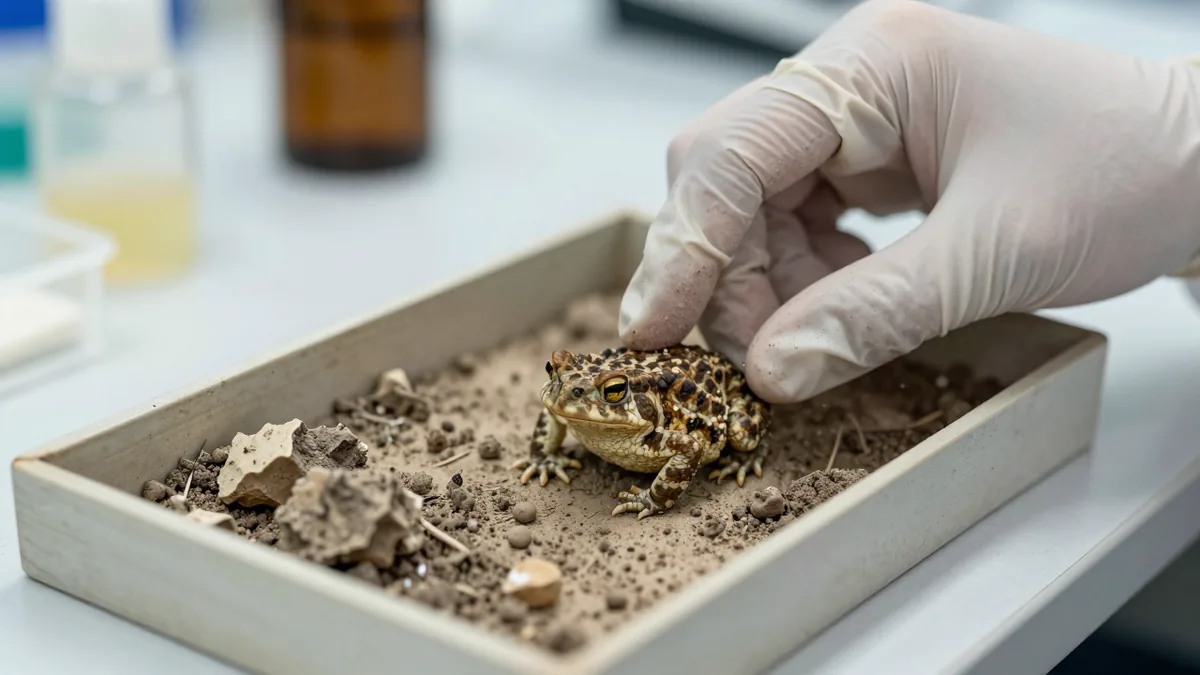
The discovery of a new extinct amphibian species at the La Brea Tar Pits is offering scientists a unique glimpse into the ancient climate of Los Angeles.
The Ice Age spadefoot toad, named Spea labreae, is an exceptionally rare find, with only one other extinct Pleistocene amphibian having been discovered in North America. Its fossils had been sitting in collections since the 1950s before a researcher noticed features that set it apart from known species.
An Unexpected Discovery in an Old Fossil Collection
Lead author Dr. Alberto Cruz did not set out to discover a new species. He began studying the Tar Pits' relatively understudied reptile and amphibian collections while working there as a Postdoctoral Fellow.
Cruz remains a Research Associate at La Brea Tar Pits and works full time as Researcher for Mexico's SECIHTI Centro de Investigación Paleontológica Quinametzin (CIPAQ), Instituto Nacional de Antropología e Historia (INAH).
"I'm really more of a paleoecologist, paleogeographer, not a taxonomist," says Dr. Cruz, who noticed unusual features in the Tar Pits specimens that distinguished S. labreae from known spadefoot toads.
At first, Cruz wondered whether the unusual bones belonged to an animal that had been sick or injured during its lifetime, which would make them an example of paleopathology. Comparisons with modern spadefoot toads eventually convinced him that the differences represented something else entirely.
Tiny Amphibians Can Reveal Ancient Climate
Large Ice Age mammals tend to attract the most attention at La Brea Tar Pits, but the much smaller reptiles and amphibians studied by Cruz can sometimes provide scientists with more detailed information about past climate and environmental conditions.
Amphibians generally do not travel long distances during their lives, and they are highly sensitive to changes in their surroundings. Those traits make them useful climate proxies. By determining where particular amphibians were present or absent, researchers can reconstruct environmental changes at a more local scale.
"If you change the environment, you change the vegetation, the climate is warmer or colder, it affects these animals directly," says Cruz.
Their usefulness comes with a major obstacle. Frogs, toads, and salamanders have delicate skeletons that do not fossilize easily, so their remains are uncommon in the fossil record outside asphaltic sites such as La Brea Tar Pits. That makes the discovery of a previously unknown small amphibian such as S. labreae especially remarkable.
Comparing Fossils With Modern Toads
To establish that the fossils represented a new species, Cruz closely examined amphibian bones from the La Brea Tar Pits collection, which had not received a detailed assessment in nearly 30 years. He documented differences in the shapes and sizes of the bones and compared the fossils with 80 specimens housed in the Herpetology Collections at the Natural History Museum of Los Angeles County and the Museum of Vertebrate Zoology at the University of California, Berkeley.
Those comparisons helped demonstrate that the La Brea fossils belonged to a distinct species of spadefoot toad rather than to an unusual individual of a known species.
Another Toad Reveals a Dramatically Different Los Angeles
The research produced another surprising discovery. Scientists identified the first known record of the Mexican burrowing toad, Rhinophrynus, in the southwestern United States.
These toads no longer live anywhere near Los Angeles. Their closest living populations are now nearly 2,500 km away in southern Mexico, indicating that the species once occupied a dramatically different geographic range.
That major shift in distribution, combined with the extinction of S. labreae, adds another piece to the complex history of environmental change as the last Ice Age came to an end. By examining how amphibians responded to those ancient changes, researchers may also gain insight into how similar animals could respond to human caused climate change today.
| Species | Description |
|---|---|
| Spea labreae | Ice Age spadefoot toad |
| Rhinophrynus | Mexican burrowing toad |
Source: sciencedaily.com