Army Ants Reveal How Biological Echo Chambers Form
A new study uses mathematical models to explain how self-reinforcing feedback loops, or 'echo chambers,' emerge in animal groups like army ants, leading to
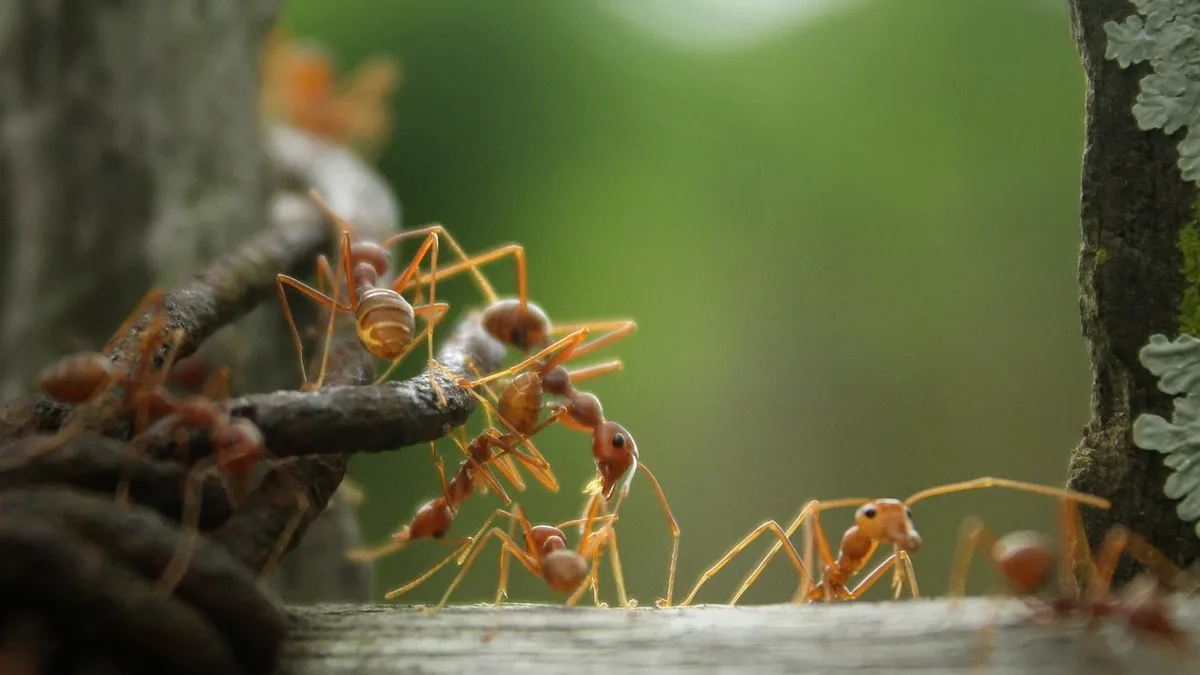
Tropical army ants can march to their deaths in a circular trap of their own making. A new mathematical study reveals how such self-reinforcing feedback loops, termed biological echo chambers, form in animal collectives and what mechanisms can shatter them.
Andrew Hein, an associate professor of computational biology at Cornell University and senior author of the study, explained the phenomenon. "They end up in this cycle where they're reinforcing the same pattern over and over again," he said. "This is a physical instance of an echo chamber, where the animals involved actually die." The research was published on September 22, 2026, in the Proceedings of the National Academy of Sciences.
The work models groups of biological agents, from birds in a flock to cells in tissue. It identifies two common constraints that make systems vulnerable to echo chambers. First, an individual often only observes a neighbor's actions, not the internal information that prompted them. Second, individuals have limited attention and can only focus on a few neighbors at any moment.
How Limited Attention Drives Dysfunction
These constraints can make individuals hypersensitive to messages from others. They begin sending and receiving similar signals back and forth, creating a closed loop. The group reaches a consensus decision that becomes completely detached from external reality. It happens when people are telling each other the same thing, but there's also an implication that this group has become unresponsive to what's actually happening in the world around them, Hein noted.
The researchers started with idealized computer models where agents shared all their underlying data and could pay attention to all neighbors. These models did not form echo chambers. However, when the team introduced more realistic constraints by removing one or both of these idealized assumptions, dysfunction emerged. The behavior of the group of agents as a whole could become just totally dysfunctional, Hein said.
Breaking the Feedback Loop
Not all is lost. The study also pinpointed factors that can prevent or dismantle these harmful cycles. Individuals on the periphery of a group play a key role. They are connected to the center but are also influenced by outsiders and can detect changes in the environment.
It's really the free spirits, the individuals who have stayed at the edge and don't have many social influences, who are the first ones to change, Hein explained. They can set off a cascade. Another breaking mechanism comes from individuals within the group who recognize their decisions are wrong and start ignoring the consensus.
According to Hein, even a small fraction of individuals occasionally exercising independent judgment can destroy an echo chamber. This insight, drawn from modeling biological collectives, provides a general framework for understanding how consensus can become pathological and how diversity of information can restore function.