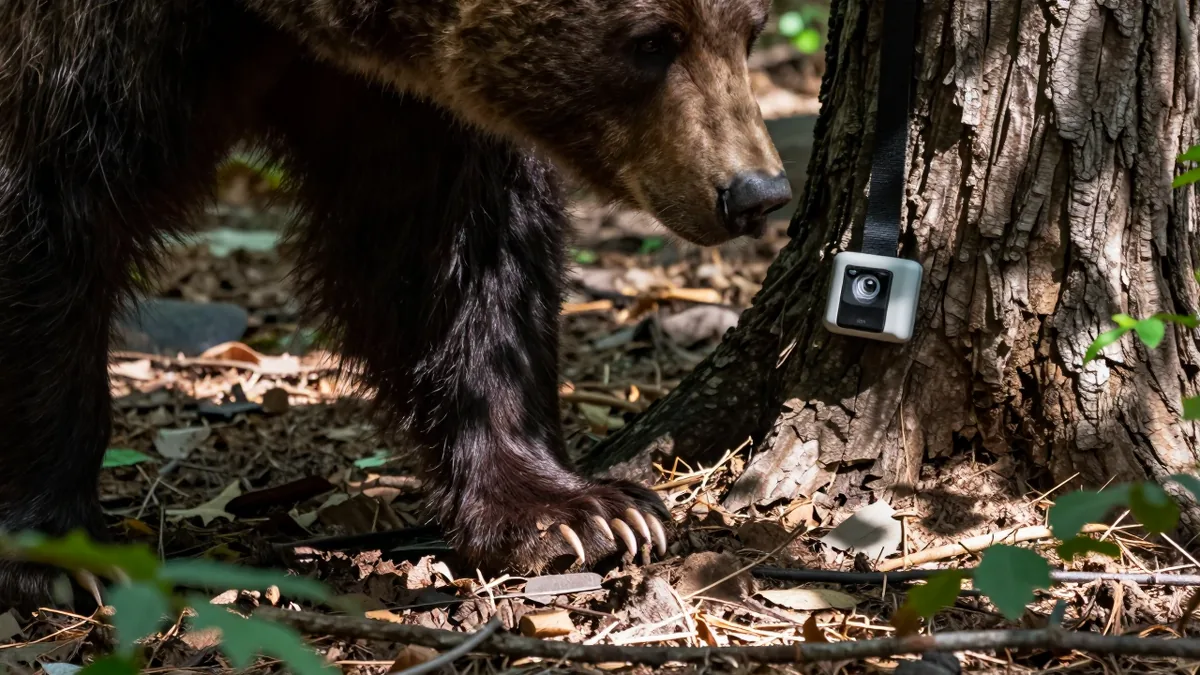
Bear Census Highlights Value of Coexistence Corridors in Central Apennines
A recent census has revealed encouraging signs for the endangered Marsican brown bear, with the population showing signs of expansion beyond its historic stronghold in Italy's Central Apennines.
Making Space for Europe's Rarest Bear The Marsican brown bear, found nowhere else on Earth, is one of Europe's most endangered large mammals. With a small population surviving in Italy's Central Apennine mountains, every bear matters. While decades of conservation have helped prevent extinction, the long-term future of the subspecies depends on more than protecting its historic stronghold. Rewilding Apennines is focusing its efforts on reconnecting the landscape beyond protected areas, enabling bears and other wildlife to move more safely and freely. This approach recognises a simple reality: for the Marsican brown bear to recover, individuals moving into new areas need more than suitable habitat - they need landscapes where they can find food, disperse naturally, and live alongside communities that want to share their surroundings with them. ## A Landmark Census The importance of this work has now been reinforced by the most comprehensive survey ever undertaken of the Marsican brown bear population. Carried out during 2025 as part of Italy's DigitAP project, the census covered around 6,000 square kilometres across the bear's entire known range. Using non-invasive sampling, researchers from ISPRA and the Charles Darwin department of Sapienza University analysed 854 hair samples and genetically identified 70 individual bears. The study estimates that around 81 Marsican brown bears now live across the Central Apennines, encompassing 43 females and 38 males. Within the historic core area centred on the Abruzzo, Lazio and Molise National Park, the population has remained stable - or increased slightly - over the past decade, with an estimated 56 bears now living here. When neighbouring areas that have recently been colonised - including Valle Roveto and the Monte Genzana Alto Gizio Reserve - are included, this figure rises to 65 bears, showing that these landscapes are now home to a single, continuous population. ## Connectivity and Coexistence are Critical One of the census's most important findings was not simply how many bears were counted, but what determines where they occur. Researchers found that habitat quality alone does not explain the low numbers in peripheral areas. Instead, bear density declines with distance from the historic core, showing that expansion is still at an early stage. Crucially, areas connected to the core through suitable habitat corridors support significantly more bears than equally distant but less connected landscapes. The study also found that areas with higher levels of human-caused mortality - such as road collisions, poisoning, and poaching - support fewer bears. While the historic core holds around 4.4 bears per 100 square kilometres, peripheral areas support only around 0.4 bears per 100 square kilometres - roughly ten times less. Researchers conclude that these landscapes could support many more bears if connectivity improves and human-caused mortality is reduced. These findings support the approach taken by Rewilding Apennines, which aims to create connected, bear-smart landscapes where wildlife and people can thrive together. By protecting and restoring the corridors that connect suitable habitat, reducing human-caused mortality, and continuing efforts to help people and bears share space, the team are helping one of Europe's rarest large carnivores move beyond its historic stronghold, reclaim more of its ancestral range, and become an even stronger symbol of a wilder, more resilient Central Apennines.