New beetle trap reveals hidden forest habitat patterns
A novel survey method using female-baited traps to capture male stag beetles has mapped fine-scale habitat conditions in Japanese broadleaf forests, offering a tool to balance timber use and biodiversity.
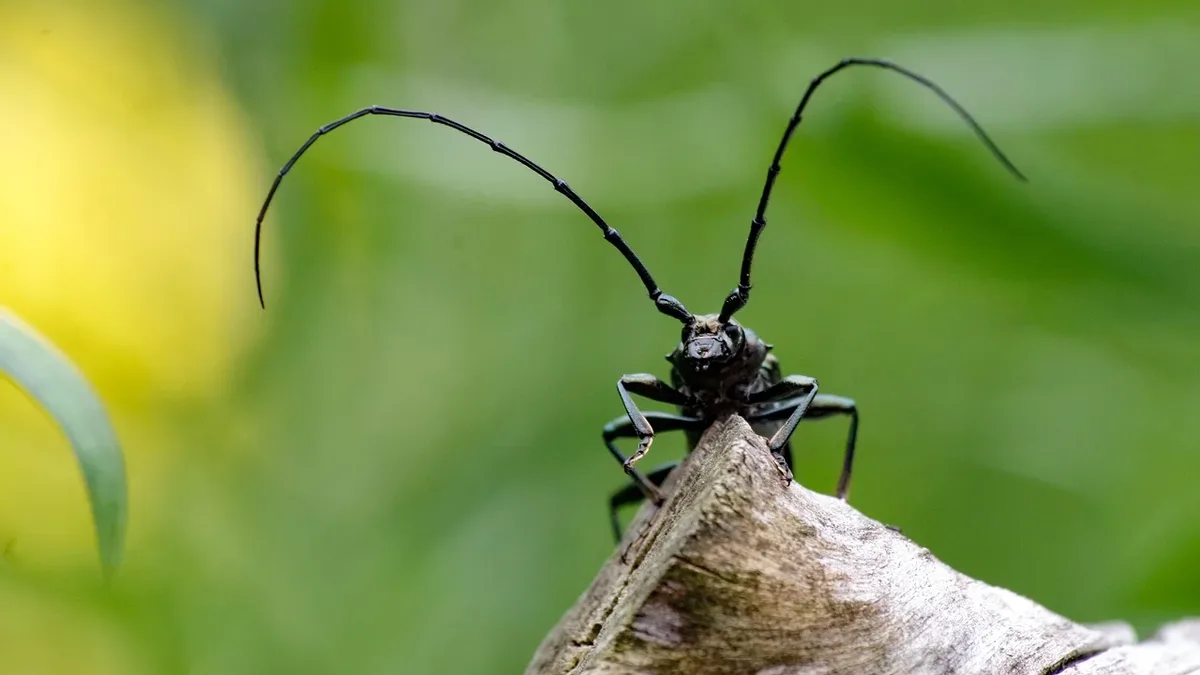
A new survey method using female-baited traps shows male stag beetles concentrate in forest interiors, revealing hidden habitat patterns in managed broadleaf forests. The study was conducted in the managed broadleaf forests of Hida, Japan, focusing on male Platycerus takakuwai, a stag beetle species typical of the region.
Researchers captured and georeferenced the beetles to trap locations. They analyzed capture counts in relation to environmental variables including weather, elevation, forest structure, and forest-edge position. Beetle capture counts increased toward forest interiors and declined toward open areas. The relationship between tree density and capture counts varies across locations rather than being uniform.
The survey used a female-attracted flight interception trap, or F-FIT. This method lures male stag beetles using traps baited with live females. The technique was applied for the first time to habitat assessment in actively managed timber forests. It demonstrates that canopy-associated insects can reveal spatial habitat patterns undetectable by ground-dwelling indicators.
Method advantages over traditional surveys
Researchers at Kyoto University developed and deployed the F-FIT technique. Conventional survey methods for Platycerus beetles rely heavily on observer skill and risk damaging fragile breeding sites. The new trap offers a standardized, repeatable method that does not require expert handling or disturb those sites.
The team compared multiple candidate models to determine which best explained variation in capture counts. The F-FIT system provided the consistent data needed for this analysis. Minori Tokito, the study's first author, stated a driving interest behind the work. "I'm interested in how forest resources can be used while maintaining habitats for wildlife."
Broader goals and ongoing work
The scientists aim to develop locally useful indicators to support forest management that balances timber use and biodiversity conservation. This goal extends to other regions beyond the study area in Hida.
Larger-scale surveys are already underway. The team aims to examine whether similar spatial patterns are observed across different forests, years, and survey dates. This ongoing work seeks to validate the method's broader applicability.
Publication and authorship details
The study was published on 6 September 2026 in the journal Forest Ecology and Management. The first author is Minori Tokito of Kyoto University.
The paper's title is 'A honey trap for Platycerus (Coleoptera: Lucanidae): Georeferenced captures indicate forest-habitat patterns in operational broadleaf forestry.' Its digital object identifier (DOI) is 10.1016/j.foreco.2026.124225.