Monkey Climbing Rethinks Human Ancestor
Wild sooty mangabey monkeys in West Africa climb trees with flexible feet, challenging ideas that human-chimp ancestors needed ape-like feet for climbing.
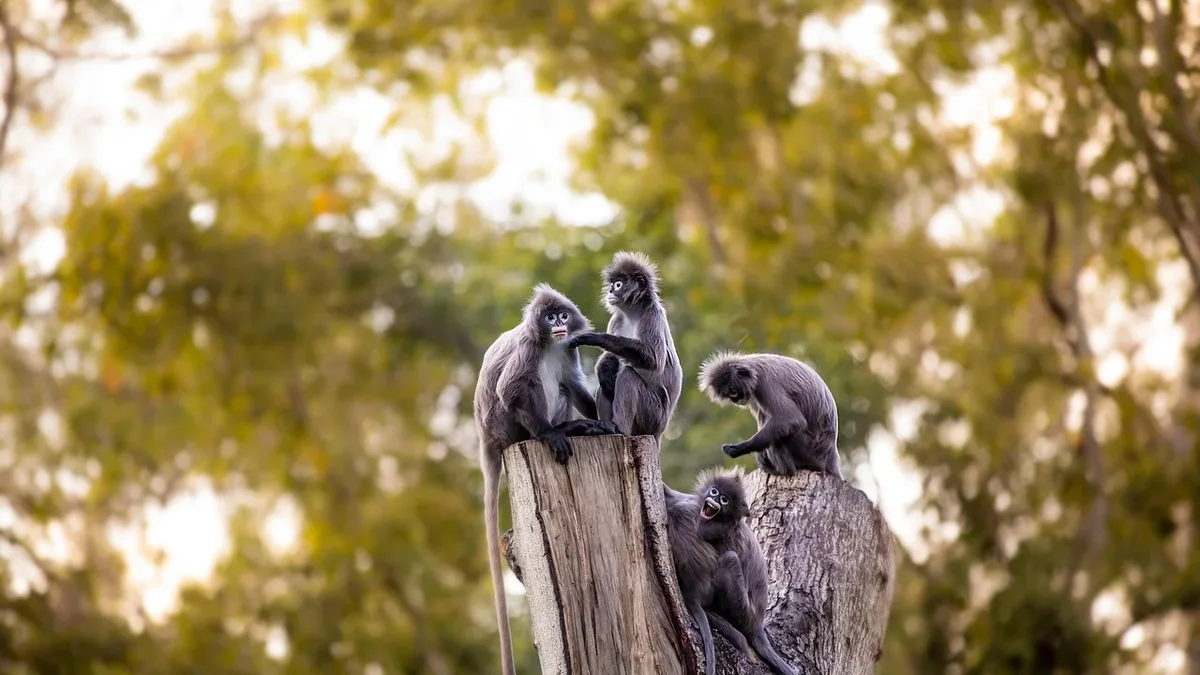
New research on wild monkeys suggests scientists may be misreading fossil feet in the story of human evolution. A study from Ohio State University shows sooty mangabeys can climb vertical tree trunks despite lacking chimpanzee-like ankles, forcing a rethink of how the human-chimpanzee ancestor moved through forests.
Rethinking What Feet Reveal
For years, a key distinction influenced ideas about our ancient ancestor. Chimpanzees, with highly flexible ankles, are adept vertical climbers. Monkeys were often viewed as relying more on their arms. This led to debates over whether the last common ancestor (LCA) of humans and chimps, which lived between 6 and 7 million years ago, had feet more like modern apes or monkeys. New video evidence from West Africa is challenging that assumption.
Researchers studied wild sooty mangabeys at the Taï Forest Monkey Project in Ivory Coast. Detailed observations showed these monkeys bend parts of their feet enough to scale narrow vertical trunks while foraging or seeking shelter. First author Luke Fannin, an assistant professor of anthropology at Ohio State, said people make behavioral inferences from fossils, and some say a monkey cannot vertically climb as well as an ape can, but they are saying there is a functional equivalence here.
The research appears in Proceedings of the National Academy of Sciences.
A New Clue to Bipedalism
Understanding how the LCA moved is crucial for piecing together the evolution of habitual walking on two legs, a trait unique to humans. The new findings suggest an ancestor with monkey-like feet might still have been a capable climber, comparable to modern apes. This complicates the reconstruction of our evolutionary past.
Fannin said part of paleoanthropology is understanding how our evolution happened, and it is often through the hallmark of how we move. The study co-director, W. Scott McGraw, noted the value of video evidence, stating that the great thing about having the video is that it allows them to capture exactly what the monkey is doing in a high-resolution manner.
Monkeys Show Unexpected Flexibility
The study measured foot flexion during climbs, revealing a surprising convergence between monkeys and apes through different anatomical means.
| Primate | Ankle Flexion (Degrees) | Midfoot Flexion (Degrees) |
|---|---|---|
| Chimpanzee | ~45 | Not Specified |
| Human (most) | ~20 | Not Specified |
| Sooty Mangabey | Not Specified | Up to 46 |
While a chimpanzee ankle can flex upward by about 45 degrees, the mangabeys achieved similar climbing capability with up to 46 degrees of flexion in their midfoot. This finding blurs long-held distinctions. McGraw said what is neat about this paper is it adds clarity, but it also makes the broader picture more fuzzy, and the notion that an ape-like foot is necessary for vertical climbing is not true.
Humans' Arboreal Connection
Vertical climbing is not exclusive to nonhuman primates. Some modern human foragers are also capable climbers, though they rely more on soft tissues than bone structure. The researchers emphasize that climbing remains part of human behavior, reflecting a deep ancestral link to trees that shaped primate anatomy.
McGraw stated that arboreality is fundamental to understanding primates - including ourselves - because it has shaped our body to a large degree. Fannin added that to settle the debate on a monkey-like or ape-like last common ancestor, more fossils are needed. The research was supported by several institutions including Dartmouth College and the U.S. National Science Foundation.